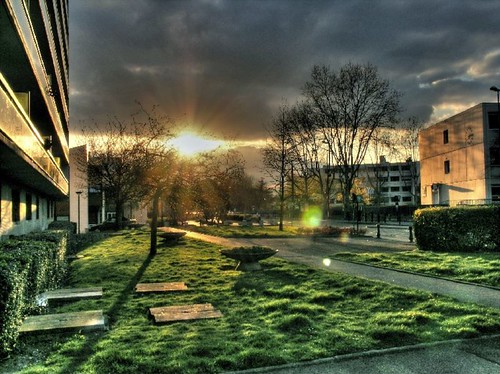
Over the past few weeks, some different landscapes have come up in conversation through the blogs - rural country landscapes, cityscapes, and suburban areas. There are also the highly pedicured magnolia and azalea golf club spots as well (like the Augusta national). Of course, some of these are not unique to the South, but all are distinctly Southern in particular ways; that is, Southern cities are not the same as Northern cities, and so forth.
Each of these landscapes offers distinct advantages and disadvantages. Try to think of the particular features of each and decide which might be your favorite. Also, think of some ways which may make each of these landscapes distinctly Southern in one way or another and share your observations.
I have noticed over the past several weeks that a topic of conversation in class and in other blog groups has been that of Southern identity - the notion of where, and what is the South.
In her last post, I really feel like Lior struck the proverbial nail on the head when she said that her “real” South is a sparse, spread out place, as indicated by her picture. Since I agree with her on this point, I have taken a similar picture from some of our property near Vidalia, GA.
In one group a few weeks ago, one person mentioned that they had traveled to many cities in the South but had never seen the stereotypical, rural, at-home South often alluded to in this course. I feel that since cities have such a high rate of immigration and emigration, that the stereotypical South isn’t as evident in many Southern cities. Instead, you must go to the rural areas. Drive an hour or two outside of the city; visit Tifton, Waycross, and Moultrie, GA; go somewhere where families have lived in that location for the past 3 generations - then you will see the “real” South.
Also, see Wikipedia's article for 'Rural area.'


| Atlanta-Sandy Springs-Marietta, Ga. | 890,211 |
| Dallas-Fort Worth-Arlington, Texas | 842,449 |
| Houston-Sugar Land-Baytown, Texas | 824,547 |
| Phoenix-Mesa-Scottsdale, Ariz. | 787,306 |
| Riverside-San Bernardino-Ontario, Calif. | 771,314 |
| Los Angeles-Long Beach-Santa Ana, Calif. | 584,510 |
| New York-Northern New Jersey-Long Island, N.Y.-N.J.-Pa. | 495,154 |
| Washington-Arlington-Alexandria, D.C.-Va.-Md.-W.Va. | 494,220 |
| Miami-Fort Lauderdale-Miami Beach, Fla. | 455,869 |
| Chicago-Naperville-Joliet, Ill.-Ind.-Wis. | 407,133 |
I sure do love the sound of a Southern accent, especially compared to a sharp New England accent. One is just inviting, warm, friendly, while the other lashes out at you.
Of course, when the British colonized the states, I imagine that differences in regional accents didn’t really exist. However, in the more than 200 years since we broke off from Britain after the American Revolution, different regions of our country has received immigrants from different parts of the world - in particular, African slaves imported into the Southern states.
This Wikipedia Article on Southern American English does a good job of giving an overview of Southern American dialects in general. The article does a good job of highlighting that there are many sub-accents in the South, something that many folks often don’t realize.
Tom Petty and Johnny Cash say it best in Southern Accent.